DeepSeek V4.1 Flash is DeepSeek's open-weight multimodal model, released on September 10, 2026. DeepSeek's model card describes a mixture-of-experts model with a 552-billion-parameter backbone, 8 billion parameters active per token while it reads your input and 16 billion while it writes, and a context window of up to one million tokens. It takes text and images and returns text, under the MIT License.
There are three broad ways to use it. You can run the weights yourself, which takes a multi-GPU server. You can call DeepSeek's API or another host. Or you can use it in Maple, where we offer it on Pro, Max and Team plans with the full 1,048,576-token window, through our protected inference path.
This guide separates what belongs to the model from what belongs to each route, so you can pick one. Sources were checked on October 15, 2026; models, plans and serving recipes change.
| What is it? | DeepSeek's multimodal mixture-of-experts model: a 552B backbone, 8B active per token in prefill and 16B in decode, and up to 1M tokens of context.1 |
|---|---|
| Is it open source? | The weights are under the MIT License, a standard permissive license.2 |
| Is it the same as V4 Flash? | No. V4.1 Flash replaced V4 Flash, and DeepSeek's API now routes the old name to the new model.3 |
| What hardware does it need? | The checkpoint is about 510 GB.4 The vLLM recipe's default needs at least 614 GB of GPU memory.5 |
| Is it in Maple? | Yes, on Pro, Max and Team plans, with a 1,048,576-token context window.6 |
| Is it private? | That depends on the route, not the model. |
What is DeepSeek V4.1 Flash?
It is a sparse model: of its 384 routed experts per layer, six run for each token, plus one shared expert. DeepSeek splits the network into a causal encoder that reads your prompt and a decoder that writes the answer, which is why it quotes two active counts: 8B in prefill and 16B in decode. That design keeps the compute per token low, especially for long inputs.
It does not shrink the model you have to store. Every expert has to be loaded, because different tokens route to different experts. The card also describes 196B parameters of "Engram" conditional memory, a lookup table the model reads as it works, which sits beside the backbone.
The card's headline change is the cache that long contexts need. DeepSeek reports a global KV cache of 890 bytes per token, about a quarter of V4 Flash's. By our arithmetic from that figure, a full million-token window comes to under a gigabyte of global cache per conversation, before the other buffers a serving engine adds. For this model the weights dominate the memory, not the context.
Is DeepSeek V4.1 Flash open source?
The weights are. DeepSeek publishes them under the MIT License, together with reference inference code and a technical report. MIT is a standard permissive license, unlike the custom licenses some open-weight models use, so building a product on the weights does not bring revenue or service conditions.
What DeepSeek does not publish is its training data. If your definition of open source requires the data, V4.1 Flash is open-weight rather than fully open.
How is V4.1 Flash different from V4 Flash?
They are separate releases, and V4.1 Flash replaced V4 Flash on DeepSeek's API. DeepSeek's release note retired V4 Flash and its vision preview on launch day. For compatibility, requests that still name deepseek-v4-flash now get V4.1 Flash. So a test that compares the two by API name may be comparing V4.1 Flash with itself.
| Attribute | DeepSeek V4 Flash | DeepSeek V4.1 Flash |
|---|---|---|
| Backbone / active parameters | 284B / 13B | 552B / 8B in prefill, 16B in decode |
| Global KV cache per token | About 4× V4.1 Flash's | 890 bytes |
| Image input | Not covered in our sources | Native, trained jointly with text |
| On DeepSeek's API | Retired; the name routes to V4.1 Flash | Served as deepseek-flash |
| Maple status | Not offered | Available on Pro, Max and Team |
The figure below puts the API changes in order. DeepSeek also routes deepseek-v4-pro requests to V4.1 Flash until a V4.1 Pro arrives, which matters if you built on V4 Pro.

What do DeepSeek's evaluations show?
They show strong vendor-reported results. DeepSeek's technical report explains the architecture behind them,7 and the model card compares V4.1 Flash with V4 Flash, V4 Pro and several frontier models, and DeepSeek's release note says it scores ahead of V4 Pro. These are DeepSeek's results: it chose the benchmarks, the settings and the baselines, and they are not Maple measurements.
The settings matter more than usual here. DeepSeek ran its instruct results at the maximum of a reasoning-effort scale that goes from 1 to 100, and its coding-agent results with its own harness and a one-million-token window. Another host or app may run the model at a lower effort or a shorter window, and get different results.
A few habits help when reading the tables:
- Match the settings. A score earned at maximum effort with a 1M window says little about a quick answer at default settings.
- Check the harness. The card itself shows the same model scoring differently across agent scaffolds on the same benchmark.
- Treat benchmarks as a shortlist. A strong coding result is a reason to try V4.1 Flash on coding work, not a promise about your codebase.
The most reliable evidence is still a test on your own representative tasks.
What hardware does DeepSeek V4.1 Flash need to self-host?
A multi-GPU server, in every published recipe we found. Running the weights yourself gives you the most control over the model, the serving stack and where your data goes. The cost is hardware and engineering time at a scale few teams have spare.
We checked the download size ourselves. Hugging Face's file listing for the repository shows 48 weight files totaling 510.3 GB.4 The listing's own parameter total, 763B, counts stored values in mixed formats, so it does not match DeepSeek's 552B backbone and 196B Engram figures; read DeepSeek's numbers for the model and the file size for your disk.
The vLLM recipe is the clearest public serving guide, updated October 13, 2026.5 It separates three budgets that are easy to confuse:
| Budget | Published figure | Scope |
|---|---|---|
| Disk | 510.3 GB in 48 files | The checkpoint as published, from our check of the file listing |
| GPU memory | At least 614 GB | vLLM's default setup, with the Engram tables on the GPUs |
| Host memory | The 183 GiB Engram tables | Moved to system memory so the model fits on smaller GPU sets |
That third budget is what makes the smaller setups work. The recipe calls a node with eight 80 GB H100 GPUs "the smallest NVIDIA node that serves this checkpoint", and only with the Engram tables moved to host memory and other memory limits applied. It also documents a single DGX Station GB300 that moves the Engram tables and 60 GiB of experts to host memory and still serves the full 1M window.
Those results belong to the recipe's configuration, and it currently needs a nightly vLLM build. Neither the recipe nor DeepSeek's card describes a consumer GPU setup. Your own needs depend on the checkpoint format, context length, concurrent users and serving engine.
Self-hosting is the right call when:
- your information must never leave hardware you control
- you need to modify, fine-tune or deeply instrument the model
- you already run multi-GPU inference and have capacity to spare
If none of those apply, ask whether the operational work buys you anything a hosted route can't. Our Kimi K3 guide works through the same question for a larger open-weight model.
How do you use DeepSeek V4.1 Flash in Maple?
Choose DeepSeek V4.1 Flash from the model picker in Maple Research on a Pro, Max or Team plan. It is not available on Free. We configure it with the full 1,048,576-token window, so a long contract set, a large codebase or months of notes can go into one conversation.
Plan details are on our pricing page. DeepSeek V4.1 Flash also appears in our model library with the other models we offer; our GLM-5.3 Flash guide covers the other model there with a million-token window.
You can upload an image while using DeepSeek V4.1 Flash in Research. The app first has a vision model describe the image, then gives that description to the model you selected.8 DeepSeek V4.1 Flash answers from the description, not a direct view of the image, which matters if your task depends on a small visual detail.
For developer tools and existing applications, Maple Proxy is our API route, using the model ID deepseek-v4-1-flash. Check the Proxy model list for its current context limit and input types before you build on it.
This route gives you two things. You get a model with a 510 GB checkpoint without provisioning the GPU memory above or tracking nightly serving builds. And your requests run through our protected inference path rather than a conventional hosted API.
The route has limits to plan around:
- Images are described, not seen. In Research, the model works from a vision model's description of each image.
- A paid plan is required. DeepSeek V4.1 Flash is on Pro, Max and Team.
- Long prompts take time. A window near a million tokens is slow to process on any route, ours included.
What information reaches each route?
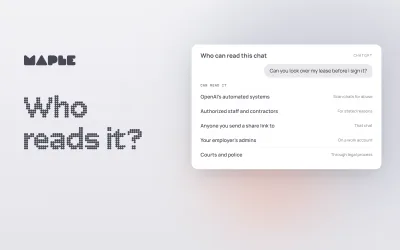
That depends on who operates the model: you, a conventional host, or Maple. Three questions get blurred together here. Who can read your prompts while they are processed, what happens to them afterward, and is any of it used for training?
Self-hosted weights. Your prompts and outputs stay on infrastructure you operate. The trust boundary is your own: your access controls, logging and retention. That makes this the strongest option when information must stay on your hardware, and it makes you responsible for securing it.
DeepSeek's API or another host. DeepSeek's API terms say it handles a developer's personal information under its privacy policy.9 That policy lists prompts and uploaded files among the data it collects, and says DeepSeek stores personal data in the People's Republic of China.10
It is a clear disclosure. Other hosts that serve the open weights set their own terms, so read them for the service and plan you would use.
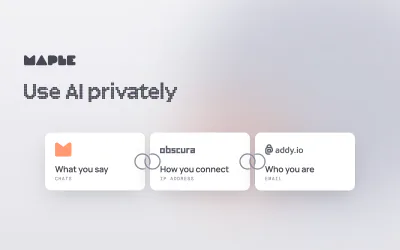
Maple. We run DeepSeek's open weights inside an attested enclave rather than calling DeepSeek's API. Your requests are encrypted before they leave your device, and our proof page explains the attestation you can check yourself.
The model runs in its own attested enclave, and Maple's enclave verifies it before forwarding a prompt. It works like certificate chains on the web: you check Maple's enclave, and Maple's enclave checks the model's. Our privacy notice covers everything outside your chats.

That design has a scope. It protects the contents of your chats: your prompts and the responses. It doesn't make information private if you've already shared it elsewhere.
It is also separate from the safety of what the model's output leads you to do. If you paste its code into production or let an agent act on its suggestions, confidential processing doesn't vouch for that code or those actions. Review outputs as you would any untrusted input.
Which route fits your task?
It depends on where your information may go, how much context you need and how much infrastructure you can run. The table compares the three routes on the same terms.
| Factor | Self-hosted weights | DeepSeek's API or another host | Maple |
|---|---|---|---|
| Setup | Multi-GPU server; nightly vLLM build at the time of writing | Account and API key; integrate | Pro, Max or Team plan; choose the model |
| Model name | The checkpoint you deploy | deepseek-flash on DeepSeek's API; other hosts vary | DeepSeek V4.1 Flash, deepseek-v4-1-flash on the API |
| Context | Up to 1M, subject to your hardware and settings | Per provider documentation | 1,048,576 tokens |
| Images | Native, per the model card | Per provider documentation | Described by a vision model in Research |
| Data boundary | Your infrastructure | The provider's terms; DeepSeek stores personal data in China | Encrypted on your device, decrypted only inside a hardware-isolated enclave |
| Cost source | Hardware, power and engineering time | Provider's pricing page | Maple plan pricing |
| Main limitation | Hardware cost and operational work | The provider processes readable requests; terms vary | Paid plan required; images are described |
A rough decision rule:
- Choose self-hosting if information must stay on your hardware, or you need control over the weights themselves.
- Choose DeepSeek's API or another host if your prompts aren't sensitive and the provider's terms fit your data.
- Choose Maple if you want the full million-token window on sensitive material without running a multi-GPU server.
Sources
- DeepSeek-AI, DeepSeek-V4.1-Flash model card, last updated October 12, 2026, accessed October 15, 2026. Source for the architecture, parameter and expert counts, Engram memory, context length, input types, KV cache figures and evaluation settings.
- DeepSeek-AI, MIT License for DeepSeek-V4.1-Flash, accessed October 15, 2026.
- DeepSeek, “DeepSeek-V4.1-Flash: Smarter, Faster, More Efficient”, September 10, 2026. Source for the release, the
deepseek-flashAPI name, the retirement of V4 Flash, the routing ofdeepseek-v4-flashanddeepseek-v4-pro, and DeepSeek's comparison with V4 Pro. - Hugging Face, repository file listing for DeepSeek-V4.1-Flash, checked October 15, 2026. Our sum of the 48 safetensors files (510.3 GB) and the listing's stored-value total.
- vLLM project, DeepSeek-V4.1-Flash serving recipe (source file), updated October 13, 2026. Source for the 614 GB default minimum, the verified hardware, the H100 and DGX Station GB300 configurations, the 183 GiB Engram tables and the nightly build requirement.
- Maple, public model configuration and Research model picker, checked October 15, 2026. Source for the plan tier, configured context window and listed input types in Maple.
- DeepSeek-AI, “DeepSeek-V4.1-Flash: Pushing the Limits of KV Cache Compression”, arXiv, submitted September 17, 2026. DeepSeek's technical report.
- Maple, Research image handling and vision helper, checked October 15, 2026. Source for image description before the selected model responds.
- DeepSeek, Open Platform Terms of Service, effective April 29, 2026, accessed October 15, 2026. Section 5.5 applies the privacy policy to a developer's personal information.
- DeepSeek, Privacy Policy, last updated February 10, 2026, accessed October 15, 2026. Source for the prompts and files DeepSeek collects and where it stores personal data.