No, not in the way most people mean it. On ChatGPT's consumer plans, OpenAI receives your chats in a form it can read.
It keeps them until you delete them, can train its models on them unless you turn that off, and lets authorized staff and contractors read some of them. Settings change how OpenAI uses your chats. None of them changes who can read them.
Every answer below comes from OpenAI's own pages and from court records. After that, we compare ChatGPT with six other AI chat services on the same questions, including one most of them can't answer yes to: can you check the claim yourself?
Can anybody see my ChatGPT chats?
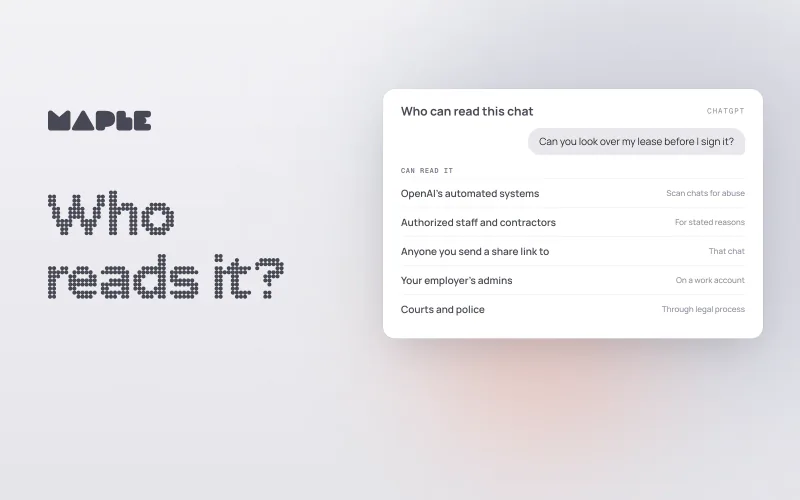
Yes, in specific cases. OpenAI's automated systems scan chats for abuse, and a limited number of OpenAI staff and contractors can read them for stated reasons. Anyone you send a share link to can read that chat, and on a work account your employer's admins can access it. Courts and police can reach chats through legal process.
OpenAI lists four reasons its personnel and service providers may access your content: investigating abuse or a security incident, answering a support request, handling legal matters, and improving model performance unless you've opted out.1 It logs that access and requires training first. Its own advice is blunt:
Please do not enter sensitive information that you would not want reviewed or used.
Flagged conversations are assessed by trained personnel. When a chat indicates "an imminent and credible risk of harm to others," OpenAI says it notifies law enforcement.2 Our guide to whether AI companies can report you to the police covers how that review and referral works across providers.
Work accounts add another reader. OpenAI's privacy policy says the administrators of a ChatGPT Enterprise or business account "may access and control your OpenAI account, including being able to access your Content."3
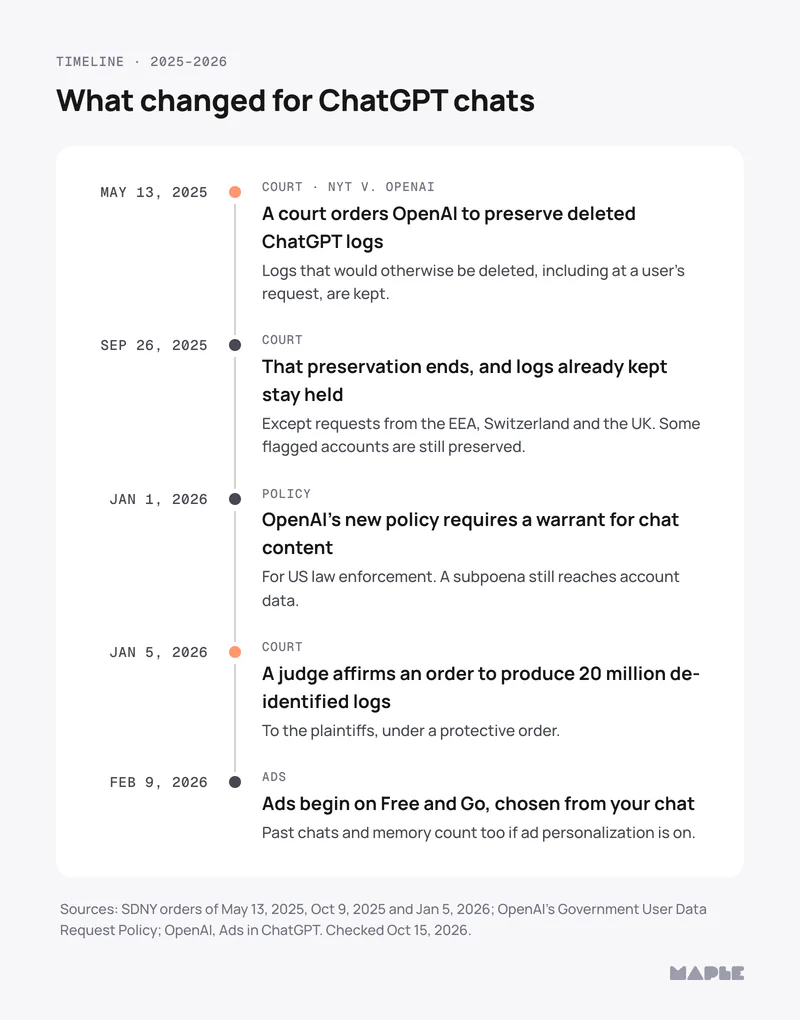
For US law enforcement, OpenAI's policy since January 1, 2026 says it discloses chat content only in response to a valid warrant or equivalent, and that it tells the user first unless the law prohibits it.4 Civil courts are a separate route, covered below.
Does ChatGPT use your chats for training?
Yes, unless you turn it off. OpenAI says it may use your content from ChatGPT to train its models. To stop that for new conversations, turn off Improve the model for everyone under Settings > Data controls. A thumbs up or thumbs down still sends that whole conversation to training.
OpenAI's help page states the feedback exception plainly: "If you choose to provide feedback, the entire conversation associated with that feedback may be used to train our models."5 It also says it takes steps to reduce the personal information in training data first. Opting out applies to new conversations only.
Memory follows the same switch. For personal accounts, OpenAI may use chats and remembered information to improve models when the setting is on.6 ChatGPT Business, Enterprise, Edu and the API are not used for training by default.
How long does ChatGPT keep your chats?
Until you delete them. Regular and archived chats stay in your account with no automatic expiry. When you delete one, OpenAI schedules it for permanent deletion within 30 days, unless it was already de-identified or OpenAI must keep it longer for security or legal reasons, such as a subpoena.7
Two details catch people out. Deleting a chat doesn't necessarily delete a memory ChatGPT saved from it, and deleting a chat doesn't delete files you saved to your Library.
The legal exception is not hypothetical. In May 2025, in The New York Times' copyright case, a federal court ordered OpenAI to preserve output logs that would otherwise be deleted, including at a user's request.8 That obligation ended on September 26, 2025, but logs preserved before then are still held, apart from requests from the EEA, Switzerland and the UK.9
In January 2026, Judge Sidney Stein affirmed orders requiring OpenAI to produce 20 million de-identified ChatGPT logs to the plaintiffs.10 He compared them with wiretapped phone calls and found the privacy interest weaker:
…the privacy interests in users' conversations with ChatGPT which users voluntarily disclosed to OpenAI and which OpenAI retains in the normal course of its business.
The timeline below shows how much changed in nine months.
Is ChatGPT's Temporary Chat private?
It's more private than a regular chat, but OpenAI can still read it. A temporary chat stays out of your history, isn't used for training while it stays temporary, and doesn't create new memories. OpenAI may keep a copy for up to 30 days for safety, and longer if it must for safety or legal reasons.
OpenAI's help page now describes two newer behaviors.11 You can save a temporary chat, which turns it into a regular chat under your normal training setting. You can also let it use your existing memories. Temporary chats don't show ads.
Is ChatGPT encrypted?
Yes, in transit and at rest, but not end to end. OpenAI says your content "is encrypted at rest and in transit between you and OpenAI, and between OpenAI and its service providers."12 That protects chats from someone intercepting the connection or stealing a disk. It doesn't keep them from OpenAI.
With end-to-end encryption, only the people in a conversation can read it. No OpenAI page claims that for ChatGPT, and its staff-access policy rules it out. OpenAI applies the encryption itself, so its systems can decrypt your chats to answer them and to let authorized staff review them.
Does ChatGPT share your data with advertisers?
OpenAI says it doesn't share your conversations with advertisers or sell your data. Since February 9, 2026, though, it has been testing ads on the Free and Go plans, starting in the US, and it picks them using your current chat. With ad personalization on, past chats and memory count too.
Plus, Pro, Business, Enterprise and Edu have no ads.13 OpenAI says ads don't appear near sensitive topics, including personal health, mental health and politics. Turning off ad personalization stops the use of other chats, but ads still follow the context of the chat you're in.
How do ChatGPT, Claude, Gemini and other AI chats compare?
They differ on training, review and retention, but every major chat app receives your regular chats in a form the company can read. The table compares consumer plans as each company describes them on its own pages. "Not stated" means we found no statement, not that the control is missing.
| Service | Can you check it yourself? | Trains on your chats | Who can read your chats | Deleted chats |
|---|---|---|---|---|
| ChatGPT (OpenAI)1 | No | Unless you turn it off | OpenAI; staff and contractors for stated reasons | Removed within 30 days, with legal and security exceptions |
| Claude (Anthropic)14 | No | Unless you opt out | Anthropic; staff only for feedback you send or Trust & Safety review | Removed within 30 days; kept de-identified up to 5 years if you allow training |
| Gemini (Google)15 | No | Yes, on by default for adults (Keep Activity) | Google; reviewers, including service providers, read a subset | Auto-deleted after 18 months by default; reviewed chats kept up to 3 years |
| Copilot (Microsoft)16 | No | Not used to train foundation models, but used to improve Copilot and choose ads | Microsoft; used to prevent abuse and improve Copilot, with some human review | No removal timeline stated |
| Meta AI (Meta)17 | No | Yes; no opt-out found on Meta's pages | Meta; automated or human review | No timeline stated |
| Grok (xAI)18 | No | Unless you turn it off | xAI; authorized personnel | Removed within 30 days, with exceptions |
| Maple | Yes, before every session | No | No one at Maple. Decrypted only inside a hardware-isolated enclave | You can delete your chats |
Some of these protections deserve credit. Anthropic says its employees can't access your conversations by default, except feedback you send and chats its Trust & Safety team reviews to enforce its usage policy.19 Claude's incognito chats and Grok's Private Chat stay out of training, like ChatGPT's Temporary Chat, and both are still kept for up to 30 days.
Gemini keeps more, for longer. Even with Keep Activity off, chats are saved for 72 hours, and chats a human reviewer has read are kept for up to three years, disconnected from your account, even after you delete your activity.
Google and Meta both say a few features run where even they can't read your data: Google's Private AI Compute for Pixel features such as Magic Cue and Recorder summaries, and Meta's Incognito Chat with Meta AI.20, 21 You can't verify either claim. Neither gives you a check you can run, neither publishes all of the code it runs there, and neither covers regular chats in the Gemini app or Meta AI.
Their own auditor says as much. NCC Group, hired by both companies, wrote that Meta's users "must trust Meta" not to slip malicious behavior into code that isn't open source.22 Of Google's system, it wrote that "it is logically unavoidable that Google ultimately has that power."23
Can you check any of this yourself?
Not for ChatGPT, or for any of the other major apps. Each publishes a privacy policy, and you trust that its staff and systems follow it and that it won't change in ways you'd object to. Policies can be good and sincerely meant. You still can't inspect the servers that carry them out.
The alternative is to make the claim checkable. A secure enclave is a hardware-isolated part of a server that the people running it can't look inside. An attestation is a signed document stating exactly which software is running there, so your app can confirm the code before it sends anything.
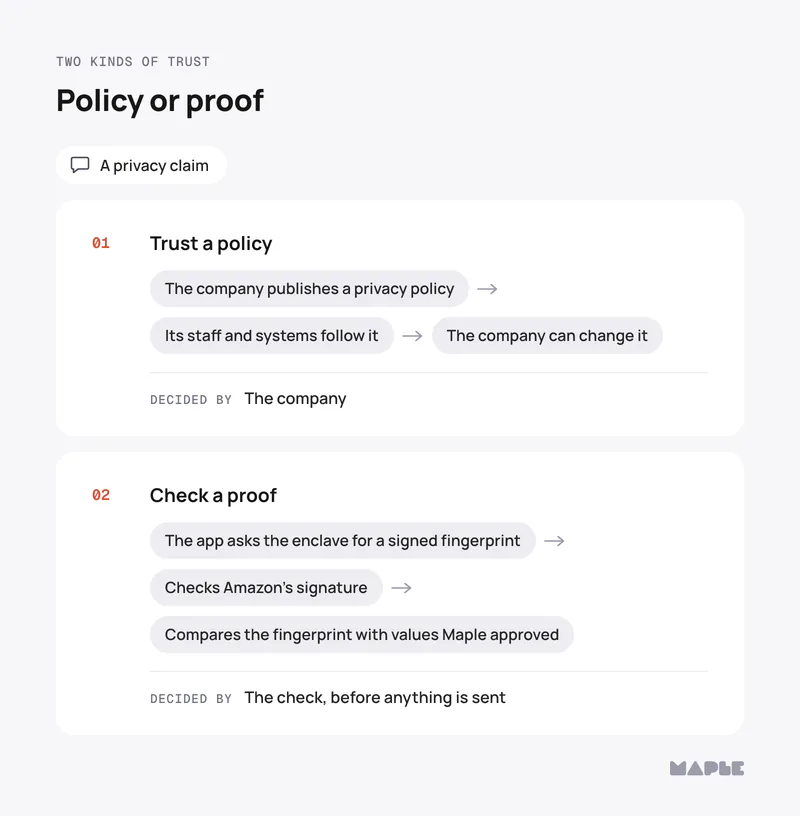
That's how Maple works. Before Maple's app sends anything, it asks the enclave for a signed fingerprint of its software and compares it with values we've approved. If any check fails, nothing is sent. You can run the same check in your browser and watch each step.
The model runs in its own attested enclave too. Maple's enclave verifies it before forwarding a prompt, and the code that does so is part of the software you check: you check Maple's enclave, and Maple's enclave checks the model's. You still rely on the hardware behind each enclave, the published code and Maple's signing key. Our proof page names all of them.
How do you make ChatGPT more private?
Change five settings and habits. They limit how OpenAI uses your chats. They don't change the fact that OpenAI receives them in a form it can read, so the most effective step is still the last one: leave out what you wouldn't want a reviewer to see.
- Turn off Improve the model for everyone under Settings > Data controls.
- Use Temporary Chat for anything you don't want in your history, and skip the thumbs up and down buttons on chats you want kept out of training.
- Review saved memories and delete the ones you don't want, since deleting a chat may not delete them.
- Delete old chats and shared links you no longer need. On Free and Go, turn off ad personalization if you don't want past chats used for ads.
- Keep personal topics off a work account, where your employer's admins can access your chats.
If you also want to hide your IP address or your real email from an AI service, our guide on how to use AI privately covers those layers. A VPN, for example, hides where you connect from but not what you say.
Is there a version of ChatGPT that's private?
Not from OpenAI. ChatGPT Business and Enterprise aren't used for training by default, and OpenAI narrows when its staff can access Enterprise chats. But your employer's admins can access them, and OpenAI still receives them in readable form. Privacy from the company itself takes a service built so the operator can't read your chats.
That's the version we built. Maple gives you a ChatGPT-style assistant on open models, without running your own hardware, and no one at Maple can read what you say. Our model library lists the models you can use.
If your work involves client or patient information, privacy tools don't replace your professional duties. Our guide to using AI safely in a therapy practice covers how those rules apply.
Sources
- OpenAI, How OpenAI handles data in consumer services, updated September 2026; checked October 15, 2026. Who can access chats and why, and access logging.
- OpenAI, Our commitment to community safety, April 28, 2026. Review of flagged conversations and notifying law enforcement.
- OpenAI, Privacy Policy, updated September 10, 2026; checked October 15, 2026. Workspace administrators, retention exceptions and ads.
- OpenAI, Government User Data Request Policy, effective January 1, 2026. Warrant requirement for content, user notice and emergency disclosure.
- OpenAI, How your data is used to improve model performance, updated September 2026; checked October 15, 2026. The training setting, the feedback exception and business defaults.
- OpenAI, Memory FAQ, updated September 2026; checked October 15, 2026. Memories, deletion and training.
- OpenAI, Chat and file retention in ChatGPT, updated July 2026; checked October 15, 2026. How long chats are kept and the 30-day deletion schedule.
- U.S. District Court for the Southern District of New York, Magistrate Judge Ona T. Wang, Order on preservation of output log data, The New York Times Co. v. Microsoft Corp. et al., No. 23-cv-11195, May 13, 2025.
- U.S. District Court for the Southern District of New York, Stipulation and Order to Terminate OpenAI's Ongoing Obligations Under the Preservation Order, No. 23-cv-11195, October 9, 2025.
- U.S. District Court for the Southern District of New York, Judge Sidney H. Stein, Order affirming discovery orders on ChatGPT output logs, In re OpenAI, Inc. Copyright Infringement Litigation, No. 25-md-3143, January 5, 2026.
- OpenAI, Temporary chat in ChatGPT, updated September 2026; checked October 15, 2026.
- OpenAI, Security & privacy, checked October 15, 2026. Encryption in transit and at rest.
- OpenAI, Ads in ChatGPT, updated September 2026; checked October 15, 2026. Plans with ads, how ads are chosen and what is shared with advertisers.
- Anthropic, How long do you store my data?, July 1, 2026; checked October 15, 2026. Deletion, training retention and incognito chats.
- Google, Gemini Apps Privacy Hub, updated October 13, 2026; checked October 15, 2026. Keep Activity, human review, 72-hour and three-year retention.
- Microsoft, Microsoft Copilot for individuals: your activity history, August 18, 2026, with the Microsoft Privacy Statement, September 2026; checked October 15, 2026.
- Meta, AI Terms of Service, effective May 13, 2026, with the Meta Privacy Policy, effective July 23, 2026; checked October 15, 2026. Review, retention and use of AI chats.
- xAI, Privacy Policy, updated October 11, 2026, with the consumer FAQ; checked October 15, 2026. Training setting, Private Chat, human review and deletion.
- Anthropic, How does Anthropic protect the personal data of Claude users?, March 16, 2026; checked October 15, 2026. Employee access and encryption.
- Google, Private AI Compute, November 11, 2025. Remote attestation for certain Pixel features.
- Meta, Introducing Incognito Chat with Meta AI, May 13, 2026. What Incognito Chat promises and that it runs on Private Processing.
- NCC Group, Public report: Meta WhatsApp Message Summarization Service review, August 27, 2025. Commissioned by Meta; covers the Private Processing summarization service.
- NCC Group, Public report: Google Private AI Compute review, version 1.4, November 8, 2025. Commissioned by Google.