Many clinicians already use ChatGPT, Claude and similar tools for practice work, and you can do it safely if you sort the work by one test: what you enter decides the rules. Work with no client information is fine in any tool you trust. De-identified information is fine only when the de-identification is real. Identifiable client information needs a business associate agreement (BAA) if you are covered by HIPAA, plus disclosure or consent and your state's rules.
In a 2025 survey by the American Psychological Association, 56% of psychologists said they had used AI tools for work at least once in the past 12 months, up from 29% a year earlier, and 67% were concerned about data breaches.1 MIT Technology Review has reported on therapists using ChatGPT without telling clients, including a client who watched his therapist put what he was saying into it during a session.2
Can therapists use ChatGPT or other AI tools?
Yes, for work that contains no client information, and for information that is properly de-identified under 45 CFR 164.514(b). For identifiable client information, HHS guidance says a HIPAA-covered practice that uses a vendor to process or store it without a business associate agreement "is in violation of the HIPAA Rules."3 State law and your ethics code apply too.
On consumer plans of ChatGPT, Claude and similar tools, what you type reaches the provider in a form the provider can read. The provider's policies decide who can review it, how long it is kept and whether it trains future models.
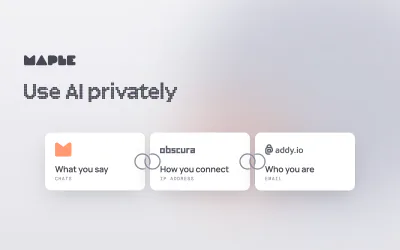
The diagram below shows where what you type can be read, on a consumer plan and on Maple.

Review can mean people, and it can reach the police. Anthropic's consumer terms reserve the right to report your inputs and outputs to law enforcement "at our sole discretion." OpenAI has said chats about harming others go to a human review team that can refer an imminent threat to police, though it said in 2025 it was not referring self-harm cases.
Session material is full of what those systems look for: a client's threat, a disclosure of abuse, suicidal thoughts. Paste it into a personal account and a stranger may read your client's words. We cover the cases so far in Can AI Companies Report You to the Police?
Today's policy is also only today's. A company can rewrite its terms whenever it chooses, and the chats it already holds are still there when it does. OpenAI's choice not to refer self-harm cases is a policy, not a limit on what it can do, and Anthropic announced a usage policy update as recently as October 2026. Large platforms answer to regulators, advertisers and public pressure, and their rules tend to move with it.
Consumer plans also come without a BAA. OpenAI lists the products it offers with a BAA, such as ChatGPT for Healthcare and ChatGPT for Clinicians, and Anthropic offers one for its API and Enterprise plans. The free and personal plans most people sign up for are not on OpenAI's list, and Anthropic's BAA page covers its commercial products (checked 10 October 2026). The test for any tool is whether a signed BAA covers your account.
Every AI task falls into one of three tiers.
| Tier | What goes in | What it needs |
|---|---|---|
| 1 | No client information: templates, handouts, letters, marketing, study | A tool you trust and your own review |
| 2 | De-identified information | Real de-identification under 45 CFR 164.514(b). Initials fail. |
| 3 | Identifiable client information: session notes, transcripts, recordings | A BAA if you are a covered entity, client disclosure or consent, and your state's rules |
What can you do with AI and no client information?
Most of the writing that fills a clinician's evenings contains no client information at all: handouts, form language, note templates, letters, policies and website copy. None of it involves protected health information, so HIPAA's vendor rules don't come into play. Your own review still does.
These four prompts need no client detail.
-
Psychoeducation handout
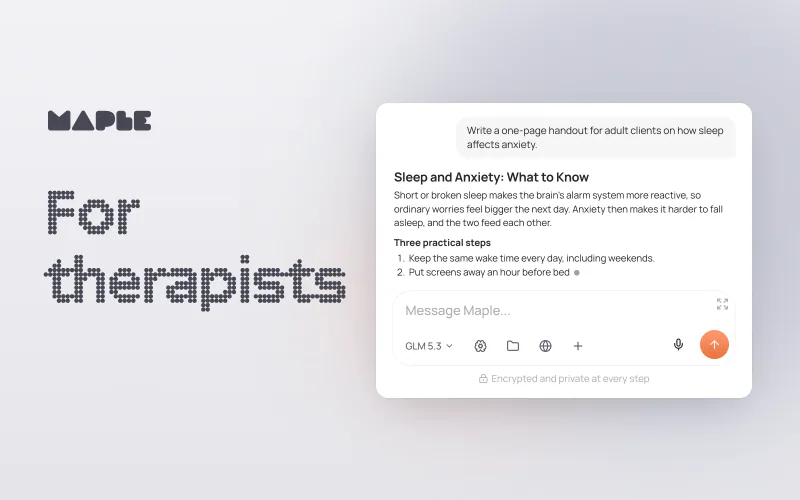
Write a one-page handout for adult clients on how sleep affects anxiety. Use plain language at an eighth-grade reading level, include three practical steps, and end with a line saying this is general education, not treatment advice.
-
Note template
Create a blank DAP progress note template with a one-line prompt under each heading. Then fill in one example for an invented client, labeled FICTIONAL EXAMPLE at the top, so I can see the level of detail to aim for.
-
Intake form wording
Draft a paragraph for my informed-consent form explaining that I use an AI assistant for administrative drafting such as templates, handouts and letters, and that I do not enter client information into it. Plain language, under 120 words.
-
Referral letter
Draft a letter to local physicians announcing that my practice is accepting new adult clients for [specialty]. Keep it under 150 words and leave placeholders for my name, license and contact details.
You can also hand the assistant a document with no client in it, such as a journal article or a blank intake packet. In Maple that works through document upload, and our getting-started guide covers setup.
Is removing the client's name enough to de-identify a note?
No, removing the name is not enough. Under HIPAA's Safe Harbor method, 45 CFR 164.514(b)(2), you must remove 18 kinds of identifiers and have no actual knowledge that what remains could identify the person.4 HHS guidance says a data set that contained patient initials "would not meet the requirement of the Safe Harbor method for de-identification."5
The identifiers include any geographic unit smaller than a state, every date element except the year, phone numbers, email addresses and record numbers. They also cover the client's relatives, employers and household members, so a sister's name or the name of a workplace counts.
If you need a label, the rule allows a code that "is not derived from or related to information about the individual." A random "Client 7" qualifies. A code built from initials or a birth date does not.
Why can a detailed story still identify a client?
HHS says a covered entity has actual knowledge "if it concludes that the remaining information could be used to identify the individual." Therapy material is full of that kind of detail: an unusual job, a publicized event, a recognizable family situation. Its guidance adds that clinical narratives that document a patient's history or lifestyle "are information rich and may provide context that readily allows for patient identification."
So de-identification fails more often than people expect. A practical rule: strip the 18 identifiers, then reread the story and ask whether someone who knows the client would recognize them. If the answer is maybe, generalize further or leave it out.
Here the design of the tool starts to matter. If a detail slips through on a consumer plan, a readable copy sits with the provider, where it can be scanned, reviewed by staff and, under some terms, reported. In a tool built so that the company running it cannot read your chats, the same slip is not readable by that company's staff. Treat that as a safety net under careful de-identification, never as a reason to skip it.
Does encryption make an AI tool HIPAA compliant?
No, encryption alone does not. HHS's cloud computing guidance says a vendor that stores or processes a covered entity's electronic protected health information (ePHI) is a business associate "even if the entity cannot actually view the ePHI."3 The practice and the vendor still need a business associate agreement, however strong the encryption.
HHS settled the question in one sentence about cloud service providers (CSPs) that hold encrypted data and no key.

A BAA is the contract in which a vendor takes on HIPAA duties for the client information it handles for you. Under 45 CFR 160.103, a business associate is a person who "creates, receives, maintains, or transmits protected health information" on a covered entity's behalf.6 The test is what the vendor does with the data, whether or not its staff can read it.
Encryption still earns its place by lowering breach risk, but HHS says "such protections alone cannot adequately safeguard" the data as the Security Rule requires. Under today's Security Rule, encryption is an "addressable" safeguard.7 HHS proposed in January 2025 to make it mandatory, and that proposal was not final when we checked on 10 October 2026.8
No AI tool is government-certified, either. The same guidance says the Office for Civil Rights "does not endorse, certify, or recommend specific technology or products." When a vendor says "HIPAA compliant," ask what stands behind the phrase, starting with a BAA.
A BAA makes a tool legally appropriate for client information. It doesn't change the technology: the vendor's systems still handle your text in readable form, and the protection is the vendor's promise and the law behind it.
Does HIPAA apply to private-pay therapists?
Not always. HIPAA covers a health care provider "who transmits any health information in electronic form in connection with a transaction covered by this subchapter," such as an electronic insurance claim (45 CFR 160.103). HHS says an entity that is neither a covered entity nor a business associate "does not have to comply with the HIPAA Rules."9
CMS says providers "who submit HIPAA transactions, like claims, electronically are covered," and standard transactions are not limited to claims. If you or a billing service acting for you ever send them, you may be covered for your whole practice. CMS publishes a covered entity decision tool.
Being outside HIPAA does not make a consumer chatbot a safe place for session notes. State confidentiality law, the state AI laws below and your licensing board's ethics code still apply.
Do therapists need client consent to use AI?
For AI that touches a client's care, the professional bodies say yes. APA says psychologists "have an ethical obligation to obtain informed consent by clearly communicating the purpose, application, and potential benefits and risks of relevant AI tools."10 Illinois, Colorado and Maine have also passed laws requiring client consent when AI is used with a recorded or transcribed session.
The counseling bodies agree:
- ACA: "Counselors should clearly inform clients about the use of AI tools in their counseling process, explaining their purpose and potential benefits."11
- NBCC: "Obtain informed consent specifically regarding AI use" and "Allow client choice to opt out of AI tools."12
None of these documents exempts back-office drafting with no client information, so a short statement in your intake paperwork about how you use AI is the cautious choice. A licensed clinical social worker explains what is at stake:
This confidentiality allows clients to be vulnerable and honest without fear of their information being misused.
Which states require consent for AI in therapy sessions?
This table has only the states whose legislature pages we read ourselves, checked 10 October 2026.
| State | Law | What it requires |
|---|---|---|
| Illinois | Public Act 104-0054 (HB 1806), effective August 1, 202513 | When a session is recorded or transcribed and AI assists: written notice of the AI and its purpose, plus written, revocable consent. Accepting general terms of use does not count. |
| Colorado | HB26-1195, signed June 3, 202614 | When a session will be recorded or transcribed through an AI system: advance disclosure of the system and its purposes, plus written, informed consent (per the legislature's bill summary). |
| Maine | LD 2082, Public Law 2026, chapter 687, approved April 13, 202615 | AI may assist with "supplementary support" "only when the client's therapeutic session is recorded or transcribed, and only if" the client is told in writing that AI will be used, its purpose and how session data is stored, used and deleted, and consents. |
Other states regulate disclosure instead of consent. Louisiana, for example, requires a licensed healthcare professional to "verbally disclose" a recording that will be transcribed by AI before it starts.16 Check your own state and licensing board, because these rules are changing.
What should you ask an AI vendor?
Ask every AI vendor, us included, six questions about the plan you would use: whether a BAA covers it, who can read what you type, whether your text trains models, what is kept, how deletion works and which other companies receive your data. Get the answers in writing.
- Will you sign a BAA that covers my account and plan?
- Who at your company can read what I type, and is that a policy or a technical limit?
- Is my text used to train models?
- What do you keep, including logs and backups, and for how long?
- Can I delete it, and what does deleting do?
- Which model providers and cloud hosts receive my data?
How does Maple handle what you type?
Maple encrypts your chats on your device and decrypts them only inside a secure enclave running open-source code you can verify. No one at Maple can read your chats. We don't offer a BAA today, and getting there is a work in progress, so for HIPAA-covered clinicians Maple is a tool for tier 1 work and properly de-identified tier 2 work.
Maple can't see what you send to the models or what they send back, and no third party can read your chats. Your encryption key is managed for you inside the secure enclave.
You can check the design yourself: our proof page shows a live attestation you can compare against the code we publish. Here are our answers to the six questions.
| Question | Maple's answer today |
|---|---|
| BAA | Not today. It's a work in progress. |
| Who can read it | No one at Maple, even as the operator. That is a technical limit, not a policy. |
| Training | No. We do not train on your conversations.17 |
| What we keep | The ordinary kind of records: account, billing and usage records, and standard infrastructure logs. None of it contains your chats.18 |
| Deletion | Your chat history is stored encrypted. You can delete your chats and your account; billing records are kept, as our privacy notice says. |
| Other companies | No third party can read your chats. Models run inside attested trusted execution environments. |
We don't offer a BAA today. We're working toward a BAA and a SOC 2 audit, and we'll say so here when that changes.
Until then, HIPAA-covered clinicians should not enter identifiable client information into Maple. We couldn't see it if you did, and no third party can read your chats. The law still asks for a signed agreement, and HHS says being unable to view the data does not exempt a vendor from that.
What Maple offers today is tier 1 and tier 2 work with a stronger backstop. If your de-identification misses something, the slip lands where our staff can't read it, and there is nothing for us to review, flag or hand over. Maple is a general-purpose assistant, not a clinical note-taking service, and our privacy notice covers the account data in full.
What should you check before you paste anything into AI?
Decide which tier the text belongs to before it goes into the chat box, because that is the step you fully control. Afterward, the output is yours. APA says psychologists "remain responsible for final decisions and must not blindly rely on AI-generated recommendations."10
- Tier 1: go ahead in a tool you trust.
- Tier 2: confirm all 18 identifiers are gone and that nobody who knows the client could recognize the story.
- Tier 3: stop unless a BAA covers your account, the client has been told or has consented, and your state's rules are met.
- Afterward: check facts and tone, move what you keep into your own files, and delete chats you no longer need.
Most of the time AI can save you sits in tier 1. Start there with one handout or one template.
Sources
- American Psychological Association, Among psychologists, AI use is up, but so are concerns, December 9, 2025. Practitioner Pulse Survey of 1,742 psychologists, fielded September 2025.
- MIT Technology Review, Therapists are secretly using ChatGPT. Clients are triggered., September 2, 2025. Reporting on therapists' undisclosed use of ChatGPT.
- US Department of Health and Human Services, Guidance on HIPAA and Cloud Computing, content last reviewed December 23, 2022; checked 10 October 2026. Business associate status without a key, the BAA requirement, the limits of encryption, and that OCR certifies no products.
- Code of Federal Regulations, 45 CFR 164.514: De-identification of protected health information, checked 10 October 2026. Safe Harbor, Expert Determination and re-identification codes.
- US Department of Health and Human Services, Guidance Regarding Methods for De-identification of Protected Health Information, content last reviewed February 3, 2025. Initials, actual knowledge and free-text narratives.
- Code of Federal Regulations, 45 CFR 160.103: Definitions, checked 10 October 2026. Business associate and covered entity.
- Code of Federal Regulations, 45 CFR 164.312: Technical safeguards, checked 10 October 2026. Encryption as an addressable specification.
- Office of Information and Regulatory Affairs, HIPAA Security Rule to Strengthen the Cybersecurity of Electronic Protected Health Information, RIN 0945-AA22, checked 10 October 2026. Proposed rule published January 6, 2025; listed as a long-term action.
- US Department of Health and Human Services, Covered Entities and Business Associates, content last reviewed August 21, 2024. Who must comply with the HIPAA Rules.
- American Psychological Association, Ethical guidance for AI in the professional practice of health service psychology, created June 2025, updated December 2025. Informed consent and responsibility for decisions.
- American Counseling Association, Recommendations for Practicing Counselors and Their Use of AI, checked 10 October 2026. Transparency and informed consent.
- National Board for Certified Counselors, Ethical Principles for Artificial Intelligence in Counseling, April 12, 2024. Consent, opt-out and counselor responsibility.
- Illinois General Assembly, Public Act 104-0054: Wellness and Oversight for Psychological Resources Act, effective August 1, 2025.
- Colorado General Assembly, HB26-1195: Psychotherapy Artificial Intelligence Restrictions, signed June 3, 2026. Official bill summary.
- Maine Legislature, LD 2082, Public Law 2026, chapter 687, approved April 13, 2026.
- Louisiana State Legislature, HB 475, Act No. 649, effective August 1, 2026. Verbal disclosure before AI transcription.
- Maple, Proof: how Maple's encryption can be verified, checked 10 October 2026.
- Maple, Privacy notice, checked 10 October 2026.