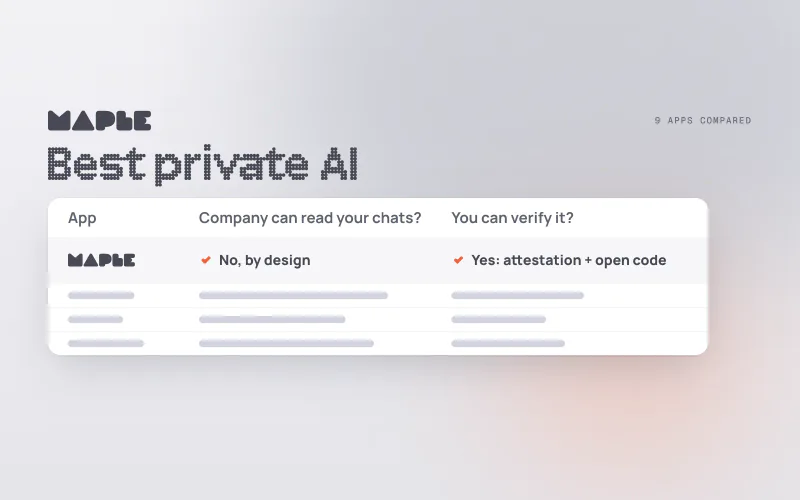
Looking for the best private AI? A private AI chat app should do two things: keep the company from reading what you type, and let you check that yourself. Maple AI (maple.ai), Confer and Privatemode are the three apps we checked that do both, and Maple is the only one of them with apps on every major platform, an API and a free plan.
We make Maple. Here's exactly how we judged every app, so you can check each claim.
Private chats are one part of using AI privately. Our guide to using AI privately covers your connection, your email and how you pay.
What a private AI chat app is (and isn't)
A private AI chat app limits who can read what you type. Every hosted app here encrypts your connection; they differ in what happens once your prompt arrives, and in what evidence you get.
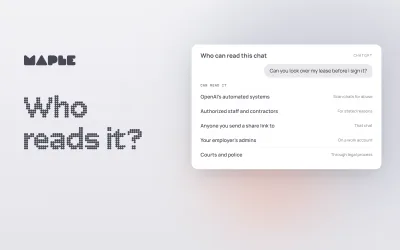
Apps sold as private fall into five privacy models:
- Policy only. The company can read your prompts, and its policy limits what it does with them. ChatGPT and Claude work this way.
- Anonymizing proxy. A middleman strips your identity and forwards readable text to a model provider. Duck.ai and Brave Leo work this way.
- Operator no-logs. The operator runs the model, sees your prompts in use and promises not to keep them. Proton Lumo and Venice's default mode work this way.
- Attested enclave. Prompts are decrypted only inside hardware-isolated enclaves, and your app checks the enclave's code by remote attestation before sending. Maple, Confer and Privatemode work this way.
- Local. The model runs on your own hardware, so there is no company in the loop.
Only the attested enclave model does both for a hosted app. The first three ask you to trust a promise; the fourth lets you check. Private also doesn't mean untraceable: an app that can't read your chats can still know which account sent them and how you paid.
Want to see the difference? Try Maple free, and check the enclave before you send anything.
How we ranked them
We read each company's own security pages, policies, pricing and app listings, and every entry links them. We didn't run lab tests of the other apps.
The first two criteria decide whether an app makes the list. The other four rank the apps that pass.
-
Can the company read your chats?
By design, not by policy.
-
Can you verify it yourself?
Remote attestation and published code.
-
Does it train on your data by default?
Read from each company's own policy.
-
Model choice
How many models, and which kind.
-
Price and free tier
The entry paid plan, and what's free.
-
Platforms
Web, phone, desktop and API.
The best private AI chat apps in 2026
1. Maple AI, best for private chat on every device
- Reads your chats: No
- Verify yourself: Yes
- Trains by default: No
- Models: 7 open-weight
- Price: Free; Pro $20/mo
- Platforms: Web, iOS, Android, macOS, Windows, Linux, API
Maple cannot see your chats. They are encrypted on your device and decrypted only inside a hardware-isolated enclave running open-source code you can verify. The model runs in its own attested enclave: you check Maple's enclave, and Maple's enclave checks the model's before it forwards a prompt, much as certificate chains work on the web.
Before the app sends anything, it checks the enclave's attestation; if a check fails, nothing is sent. The code is on GitHub under the MIT license. You still rely on the hardware behind each enclave, the published code and Maple's signing key.
It passes both tests, and it's the only app that does so with apps for every major platform, an OpenAI-compatible API and a free plan. Maple offers seven open-weight chat models, including GLM 5.3, Kimi K3 and DeepSeek V4.1 Flash. You can sign up without an email and pay with Bitcoin, as our guide to using AI privately explains.
Where Maple falls short: open-weight models only, so no GPT or Claude, and no BAA or independent audit yet; we're working toward a BAA and a SOC 2 audit.
Best suited for: anyone who wants private AI chat on every device, with a privacy claim they can check.
Checked 15 Oct 2026.
2. Confer, an enclave chat app for web and iPhone
- Reads your chats: No
- Verify yourself: Yes
- Trains by default: No
- Models: Open models, not named; no model picker
- Price: 20 messages/day free; $34.99/mo
- Platforms: Web, iOS (also runs on Apple silicon Macs)
Confer encrypts prompts from your device into a trusted execution environment, after the client checks its attestation against a logged release. Its builds are bit-for-bit reproducible, and it publishes the source for its server image and proxy so anyone can rebuild and compare, per Confer's private inference post. In its words, "Confer cannot read your prompts or responses—not by policy, but by design."5
Its privacy policy says history is stored encrypted and not used for training. Confer was created by Signal founder Moxie Marlinspike, who wrote in March 2026 that he will work to integrate Confer's privacy technology into Meta AI, while Confer continues as an independent company; no timeline was given.
Sign-up is open. Confer launched on the web in December 2025 and on iOS in May 2026, and the free Guest plan includes 20 messages a day and 5 saved chats.
Where it falls short: Membership costs $34.99 a month, the most expensive plan here. Confer uses open models and doesn't list which ones, and there's no model picker. There's no public API, and an Android app is "in the works." Parts of its server code are published on GitHub,9 but its apps aren't open source.
Best suited for: people who want an enclave app from Signal's founder and don't need to choose a model.
Checked 15 Oct 2026.
3. Privatemode, attested AI with an API, hosted in the EU
- Reads your chats: No
- Verify yourself: Yes
- Trains by default: No
- Models: 3 chat models15
- Price: 5M free tokens, then per token
- Platforms: Web, API
Privatemode, from Edgeless Systems, runs models in confidential VMs and GPUs. Its client proxy or SDK verifies the deployment before sending, and builds are reproducible. Prompts "aren't stored after a request completes, and they aren't used for training," and are processed exclusively within the EU, according to its trust and compliance page.
Edgeless holds ISO 27001, and Privatemode meets the BSI C5 attestation criteria. The free tier gives 5M tokens at sign-up plus 1M a month.
Where it falls short: there are no mobile apps, the chat app is basic, and metadata such as IP address and token usage is kept for up to 90 days. The code is source-available, and the hosted web app adds Edgeless and a network provider to what you trust.16
Best suited for: EU companies that want attested inference billed per token, processed only in the EU.
Checked 15 Oct 2026.
Apps often called private, and what they protect
These apps appear on most private AI lists. Each protects something real, but in each one the company or a model provider can read your prompts, and there's nothing for you to check. We don't rank them.
Proton Lumo
Lumo stores your chat history with zero-access encryption, so Proton can't read your saved chats. That encryption covers history, not processing. Proton's security model post says "the LLM gets to see the decrypted user message and process it directly," and that the server forgets the request once the response is generated.
Proton runs the models on servers it controls in Europe and says on its Lumo privacy page that it keeps no logs of prompts or replies and doesn't train on your chats. Lumo Plus costs $12.99 a month. Checked 15 Oct 2026.
Venice
Venice labels each model with one of four modes on its privacy page. With "Anonymized" models, the provider "sees and likely saves your prompt." The default "Private" mode runs on Venice or partner GPUs, which Venice calls "Trust-based."
The "TEE" and "E2EE" modes on Pro use enclaves verified by remote attestation, which Venice's TEE docs expose through the API; 12 text models run in E2EE mode27. Its privacy policy doesn't address training on chat content. Checked 15 Oct 2026.
Duck.ai
DuckDuckGo removes metadata such as your IP address and forwards prompts to OpenAI, Anthropic and together.ai, per its page on what Duck.ai shares. So the provider sees your text, but not who sent it. Two open models are processed in a trusted execution environment, which DuckDuckGo doesn't let you verify.
Its privacy terms say providers don't train on prompts and delete them within 30 days, with limited exceptions; its help page says right after replying, with exceptions. Paid plans start at $9.99 a month. Checked 15 Oct 2026.
Brave Leo
Leo proxies requests "through an anonymized server so the request and user-address cannot be linked," per Brave's launch post. Brave's browser privacy policy says "We don't store or retain prompts, responses, context, or personal data on our servers."
Whoever runs inference still sees your prompts, and the policy doesn't name those hosts. Brave's only enclave model is in its Nightly test build, where Brave performs the check, not you. Leo Premium costs $14.99 a month. Checked 15 Oct 2026.
ChatGPT and Claude with privacy settings
OpenAI's consumer data FAQ says authorized staff and contractors can access content for abuse, security, support and legal reasons. ChatGPT trains on Free, Plus and Pro chats by default unless you turn it off in data controls, and OpenAI may keep a Temporary Chat for up to 30 days.
Anthropic uses your chats for training if you choose to allow it, and keeps incognito chats for 30 days by default. These settings change what happens to your chats, not who can read them; more in Is ChatGPT private? Checked 15 Oct 2026.
Also checked
- Meta AI Incognito Chat. It runs on Meta's Private Processing system, an attested enclave reached through a third-party relay,44 and Meta says "no one — not even Meta — can read your conversations."45 It works only inside WhatsApp and the Meta AI app, and those apps are closed source.
- Kagi Assistant. It sends prompts to third-party model providers,46 under a policy that bars training and sharing your account details, and deletes threads after 24 hours of inactivity by default.47 It is mainly part of a search subscription.
- Mistral Vibe, formerly Le Chat. Mistral uses input and output to train its models by default unless you opt out.48
If you'd rather run it yourself
- Reads your chats: No one; it runs on your device
- Verify yourself: Ollama and Jan are open source
- Trains by default: No
- Models: Any open-weight model your hardware can run
- Price: Free
- Platforms: macOS, Windows, Linux
A local app runs the model on your own computer, so there's no company to trust. LM Studio says "none of your messages, chat histories, and documents are ever transmitted from your system." Ollama and Jan say the same of local use, and both are open source.
The trade-offs are hardware and model size. LM Studio recommends 16GB or more of RAM, models that fit on a laptop are smaller than large hosted ones, and your history is only as safe as your device. If you need everything fully offline, it's the right tool. Checked 15 Oct 2026.
Side-by-side comparison
Only the first three rows pass both tests. Platforms for the ranked apps are in each entry above.
| App | Company can read your chats? | You can verify it? | Trains on chats by default? | Price (free tier / paid) |
|---|---|---|---|---|
| Maple AI | No, by design | Yes: attestation + open code | No | Free; $20/mo |
| Confer | No, by design | Yes: attestation + reproducible builds | No | 20 messages/day; $34.99/mo |
| Privatemode | No, by design | Yes: attestation + reproducible builds | No | 5M free tokens; per token |
| Proton Lumo | Yes, while answering; policy says no logs | No | No | Free; $12.99/mo |
| Venice | Depends on the model's mode | Only TEE and E2EE models, via API | Not stated | 10 prompts/day; $18/mo28 |
| Duck.ai | The model provider can, without your identity | No | No, by contract | Free; $9.99/mo |
| Brave Leo | The inference host can | No | No | Free; $14.99/mo |
| ChatGPT / Claude | Yes | No | ChatGPT yes; Claude if you allow it | Free; $20/mo40, 43 |
| LM Studio, Ollama, Jan | No one; it runs on your device | Ollama and Jan are open source | No | Free |
Each row's sources are linked in that app's section above.
Which one fits you
| If you need… | Pick | Why |
|---|---|---|
| Everyday private chat on every device | Maple | Attested enclave on web, phone and desktop, with a free plan |
| Somewhere for sensitive personal or work material | Maple | No one at Maple can read your chats, and you can check |
| A private API for your own tools | Maple | OpenAI-compatible API through Maple Proxy |
| AI for a team | Maple Team | $30 per user, pooled credits |
| AI for therapy, clinical or legal work | Talk to your compliance lead first | Encryption doesn't settle HIPAA or professional rules; Maple has no BAA yet |
| Everything fully offline | LM Studio, Ollama or Jan | The model runs on your own machine |
To go further, our guide to using AI privately covers your connection, email and payment too. For clinical work, see using AI safely in a therapy practice.
Check it yourself
A no-logs promise can't be checked from outside. An attestation can. When you open Maple, the app asks the enclave for a signed attestation document and checks four things: a fresh random challenge, a certificate chain back to the enclave platform's published root, a valid signature, and an enclave image fingerprint that matches a release Maple approved. If any check fails, nothing is sent.

You can run the same check in your browser, and the repository documents how to rebuild the enclave image and compare its fingerprint with the public source. The proof page walks through each step.
Try Maple free
The quickest way to judge a private AI app is to use one and check it. Maple has a free plan, and no credit card is required to sign up. Your chats are encrypted on your device and decrypted only inside a hardware-isolated enclave, and the app checks that enclave before it sends anything.
The same account works on web, iPhone, Android, Mac, Windows and Linux. You can also sign up without an email and pay with Bitcoin. Pro, at $20 a month, adds every model, image and document upload in the apps, and API access. Start a free Maple chat, then run the check yourself on the proof page.
Sources
- Maple, How Maple works: private AI you can check. Enclave design, attestation checks, training and audit status.
- Maple, Pricing. Plans, Free plan features and models.
- Maple, Download Maple. Platforms.
- Maple, Maple source code. MIT license, enclave service and approved image fingerprints.
- Confer, Confer: Private AI. In-app description: models, platforms, Guest plan and Membership.
- Confer, Private inference, January 2026. Attestation, reproducible builds and transparency log.
- Confer, Privacy policy, October 2026. Encryption, stored history and training.
- Apple App Store, Confer Private AI. Membership price, iOS release and platforms.
- Confer, ConferLabs on GitHub. Published server repositories: one Apache-2.0, one with an AGPL-3.0 component, one without a license.
- Confer, Confer is bringing foundational AI privacy to Meta, March 17, 2026.
- Confer, Confessions to a data lake, December 23, 2025. First public release on the web.
- Privatemode, Attestation overview. Client-side verification and reproducible builds.
- Privatemode, Trust and compliance. Retention, training, EU processing, metadata and certifications.
- Privatemode, Pricing. Free tokens and per-token pricing.
- Privatemode, Models.
- Privatemode, Web app. What the hosted web app adds to the trusted computing base.
- LM Studio, Privacy policy. Local use and cloud services.
- LM Studio, System requirements. RAM recommendation.
- Ollama, Privacy policy. Local use.
- Jan, Privacy. Local storage and remote APIs.
- Proton, Lumo security model: how Proton makes AI private. Encryption in transit and decryption on Proton's servers.
- Proton, Lumo privacy. No-logs policy, training, models and hosting.
- Proton, Lumo pricing and plans.
- Venice, Privacy in Venice. The four privacy modes and local history.
- Venice, TEE and E2EE models. Attestation through the API.
- Venice, Privacy policy, effective June 2, 2026.
- Venice, All models. Model counts by mode.
- Venice, Pricing. Free plan and Pro price.
- DuckDuckGo, What information does Duck.ai share with model providers?. Providers and enclave-processed models.
- DuckDuckGo, Duck.ai privacy policy and terms of use. Retention, training and local history.
- DuckDuckGo, How does Duck.ai protect my privacy?. Provider deletion and its exceptions.
- DuckDuckGo, DuckDuckGo's Pro plan, March 18, 2026. Plus and Pro prices.
- Brave, Leo, Brave's AI browser assistant. The anonymizing proxy.
- Brave, Browser privacy policy, updated September 23, 2026. Retention and training.
- Brave, Brave Premium. Leo Premium price.
- Brave, Verifiable privacy and transparency: a new frontier for Brave AI privacy, November 20, 2025. The Nightly enclave model and who verifies it.
- OpenAI, Data usage for consumer services FAQ. Who can access chats.
- OpenAI, How your data is used to improve model performance. Training default and opt-out.
- OpenAI, Temporary Chat FAQ.
- OpenAI, ChatGPT pricing.
- Anthropic, Is my data used for model training?.
- Anthropic, Use incognito chats.
- Anthropic, Claude plans and pricing.
- Meta, Building Private Processing for AI tools on WhatsApp, April 29, 2025. Attested enclave and third-party relay.
- Meta, Introducing a completely private way to chat with AI, May 13, 2026.
- Kagi, LLMs and privacy. Model providers.
- Kagi, Kagi Assistant. Training, account sharing and thread deletion.
- Mistral AI, Do you use my user data to train your artificial intelligence models?.