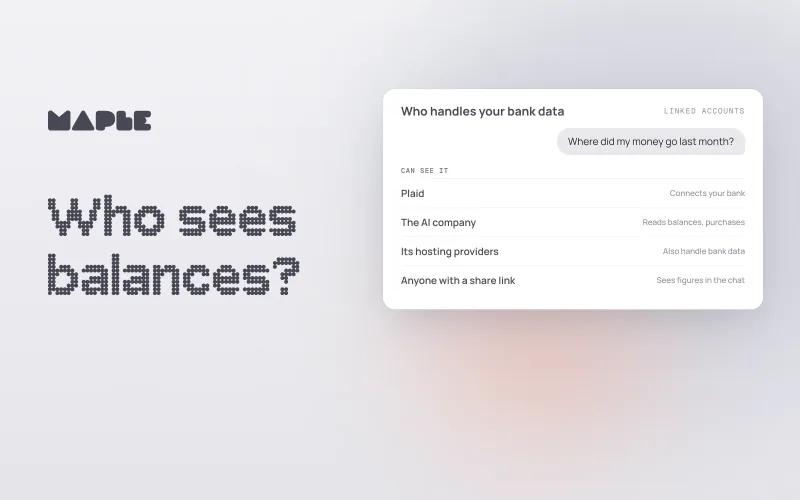
It's safe from theft, but it isn't private. The link is read-only and runs through Plaid, so no one can move money through it, and you sign in to your bank in Plaid's screens rather than in the chat. What you give up is the conversation: it lives with the AI company, stored in your chat history, readable by its staff in defined cases, and kept under its retention and training rules.
Personal Finance in Claude prompted this guide, and Finances in ChatGPT works the same read-only way. Both companies publish their storage, access, retention and training rules. The comparison below draws on their own pages, followed by how to unlink and delete, and a way to get help with money where the provider can't see the conversation.
What can an AI assistant see when you link your bank?
Through Plaid, the assistant reads your account names, balances and transaction history, and it can't move, manage or invest your money. Claude reads up to 24 months of transactions plus balances and credit limits. ChatGPT can also show net worth, portfolio holdings and, through a separate Experian connection, your credit score. The table compares the two features as each company's pages describe them.
| Personal Finance in Claude | Finances in ChatGPT | |
|---|---|---|
| Who can use it | US beta on Pro, Max and Ultra; not Free, Team or Enterprise1 | Free, Go, Plus and Pro in the U.S.2 |
| What it reads | Account names, types and last four digits (a full number can appear if your bank writes it into a name or description); balances and credit limits; up to 24 months of transactions | Plaid-linked accounts, net worth, portfolio and holdings; credit report through a separate Experian connection |
| What it can't do | Move, manage or invest money | Move money, pay bills, make trades, change account settings, open or close accounts |
| Training | Hub chats aren't used for training; outside the hub, your settings apply | Follows your ChatGPT training setting, on by default for personal Free, Plus and Pro3 |
| Staff access | Not by default; with your feedback, or Usage Policy review by designated Trust & Safety staff4 | Limited authorized staff and service providers: abuse or security, support, legal, model improvement unless you opt out5 |
| After you unlink | Reads stop; what was said stays in chats, artifacts and shared links | Synced data deleted within 30 days at OpenAI and Plaid; chats stay |
Plaid handles the bank sign-in under its own terms and privacy policy.
Where do your financial chats end up?
Your figures land in the conversation itself, and they stay in your chat history until you delete the chat.1 Anthropic adds that the service providers that host Claude also handle bank data. A Claude artifact that used your bank data also stays until you delete it, even after you delete the chat.
On the ChatGPT side, OpenAI says content is stored on its own systems and on its trusted service providers' systems in the US and around the world.5 Finances can also save context to financial memories, which you can view or delete from the Finances page.2
A shared chat link shows the figures from your accounts to anyone who has it.6 Anthropic's advice is to treat a public link as public, and turning a link off can't remove copies someone already made.
Who at the AI company can read those chats?
Not by default, but each company lists the cases where its people can. Anthropic says its employees can't access your conversations unless you share them as part of giving feedback or a review is needed to enforce its Usage Policy, and then only designated members of its Trust & Safety team on a need-to-know basis.4
There is one more Claude case. When model improvement is on, chats outside the Personal Finance hub can be reviewed for training by a small number of personnel, after Anthropic de-links them from your user ID.7 On sensitive data in general, Anthropic's help page is direct:
we also recommend being thoughtful about sharing highly sensitive personal details such as: Financial information (SSN, credit card numbers, bank account details)
Anthropic removes a deleted chat from your history immediately and from back-end storage within 30 days.8 It keeps inputs and outputs for up to 2 years if its automated systems flag a chat, and it may keep chats as the law requires.
OpenAI says a limited number of authorized personnel, plus trusted service providers bound by confidentiality, may access content for four reasons: investigating abuse or a security incident, support, legal matters, and improving model performance unless you opt out.5 It deletes cleared chats within 30 days unless they were already de-identified or it must keep them for security or legal reasons. Its own advice is plain: "Please do not enter sensitive information that you would not want reviewed or used."
None of this is misconduct. These are ordinary rules for a regular AI service, and both companies publish them. The consequence is still real: a company that can access stored chats in these cases holds a readable copy of your financial life. So does anyone who gets into your AI account, who can't move money through the feature but can see balances, payees and spending habits.
Turn on two-factor sign-in for your AI account before you link a bank. With it on, a stolen password isn't enough to open your balances and transaction history.
Are your financial chats used to train AI?
It depends on the feature, where you ask, and your settings. Claude doesn't train on chats in the Personal Finance hub, while ChatGPT finance chats follow the same training setting as the rest of your account, which is on by default for personal Free, Plus and Pro workspaces.
Anthropic's help page states the Claude rule this way: "When you chat with Claude in the Personal Finance hub, those conversations aren't used to train our models. For anything you share with Claude outside the hub, your privacy settings apply."1 Outside the hub, chats are used to improve Claude if you've allowed it, so a finance question asked in a regular chat falls under that setting.
OpenAI says conversations with Finances follow the same model training settings you choose across ChatGPT.2 Temporary chats can't use your connected accounts at all. Our guide to ChatGPT's training settings shows where to check and change them.
Feedback is a second route on both services. OpenAI says a thumbs up or thumbs down can bring the entire conversation into training, and Anthropic lists feedback among the ways your chats may be used.3, 9
Training is only one part of the picture. Storage and staff access, covered above, apply whether or not a chat is ever trained on.
How do you unlink your bank and delete what you said?

Unlink in the AI app, disconnect at Plaid, then delete the chats, artifacts, shared links and memories that hold your figures. As the excerpt above shows, all three companies say the same thing in their own words: disconnecting stops new reads, and removing what was already shared is a separate job.
Unlinking doesn't delete what was already said. Work through all three places:
- Claude: open Personal Finance, choose Manage linked accounts, then Unlink for one bank or Unlink all banks. You can't unlink a single account within a bank, and if your paid plan ends, your banks stay linked until you unlink them.1
- ChatGPT: go to Settings > Apps > Finances and disconnect. OpenAI deletes synced account data from its systems within 30 days, and Plaid deletes the data tied to that connection within 30 days.2
- ChatGPT memories: delete your financial memories separately from the Finances page.
- Plaid: sign in at my.plaid.com and use Disconnect app to stop future sharing, or Delete from Plaid to remove the data Plaid holds.10, 11
- Your conversations: delete the chats, Claude artifacts and shared links that used your accounts.
How can you get AI help with money without handing over the conversation?
Ask in an assistant whose provider can't read your chats, and paste in only the figures you choose instead of linking a live feed from your bank. Maple cannot see your chats. If you'd rather verify that than take our word for it, here is how to check it yourself.
Maple doesn't connect to banks, so there is no account link to manage or unlink. You bring the numbers yourself, which means you decide exactly what the conversation contains.
A practical way to start: copy a few months of transactions from your bank's site or statement, remove account numbers and names, and paste them in with your question. Scan the descriptions as well, since some banks write full account numbers there.
Begin with one question you'd otherwise ask a linked assistant, such as where last quarter's spending went, and paste only the rows that answer it. Check any totals against your statement before you act on them.
Sources
- Anthropic, Use Personal Finance in Claude. Claude Help Center page covering availability, read-only access, what Claude reads, the hub training rule, chat history, artifacts and unlinking.
- OpenAI, Finances in ChatGPT. OpenAI Help Center page covering availability, what Finances reads and can't do, training settings, financial memories, temporary chats and disconnecting.
- OpenAI, Data controls in ChatGPT. Supports default-on data sharing for personal Free, Plus and Pro workspaces and the feedback route into training.
- Anthropic, How does Anthropic protect the personal data of Claude users?, March 16, 2026. Supports employee access only with feedback or for Usage Policy review by designated Trust & Safety staff.
- OpenAI, How OpenAI handles data in consumer services. Supports personnel access cases, storage with service providers, deletion within 30 days and OpenAI's advice on sensitive information.
- Anthropic, Public links for shared chats. Supports that anyone with a link sees account figures and that disabling a link can't remove existing copies.
- Anthropic, I would like to input sensitive data into my chats with Claude. Who can view my conversations?. Supports de-linking before review, limited access by training personnel and Anthropic's advice on financial details.
- Anthropic, How long do you store my data?, July 1, 2026. Supports 30-day back-end deletion, retention of flagged chats and legal holds.
- Anthropic, Is my data used for model training?, March 16, 2026. Supports feedback as a route by which chats may be used.
- Plaid, How do I disconnect my financial accounts from an app?. Supports that disconnecting stops future sharing only.
- Plaid, How do I delete financial accounts from the Plaid Portal?. Supports deleting data Plaid holds through the Portal.